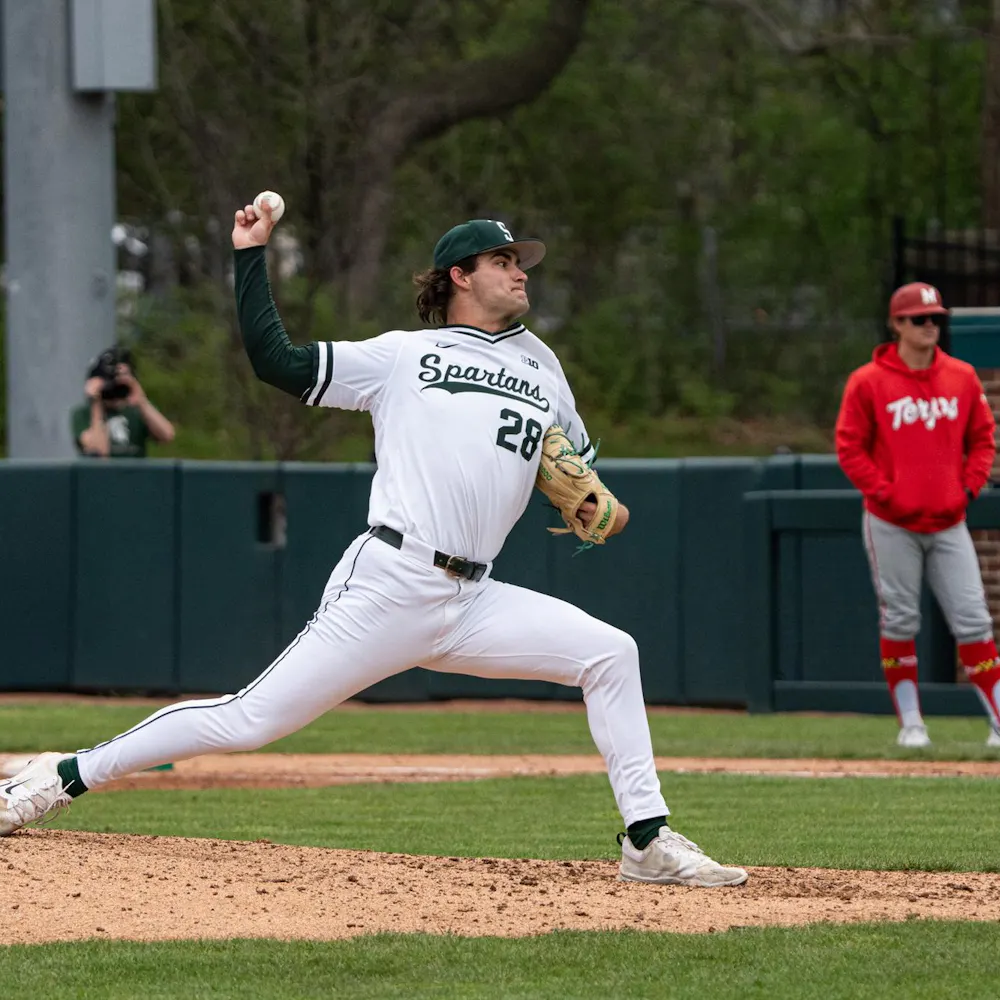
It was, in all senses of the word, an upset.
For fans watching the Spartans men's basketball team fall during the first round of the NCAA tournament to George Mason University, it was a heartbreak.
But for East Lansing, a community which has become familiar with the annual excitement of sending a team to tournament, it was the end to a season of preparations. For months, police have trained, administrators have planned, players have practiced and fans have waited for that electricity to begin again, with harsh images of last year's April 2-3 disturbances still clear in their minds.
These are brief glimpses of four people immersed in the buildup and eventual halt of the community's NCAA tournament preparation.
Two months and counting
On Jan. 18, MSU starting point guard Drew Neitzel was feeling superstitious.
"If something works, I keep doing it," Neitzel said.
That meant sticking to routines, keeping his thoughts only on upcoming games and away from thinking about a couple of recent losses. It also meant working to ignore pressure from fans, who've had a history of strong reactions to MSU wins and losses, he said.
"Right now, we're just trying to take each game one at a time," Neitzel said.
He tried to ignore the annual excitement of March Madness.
"But of course, you're always going to think about it," he said. Less than a year ago, the excitement of the tournament season led fans and police to clash following the team's loss in the Final Four, but Neitzel said the team tried to ignore that event and keep basketball in perspective.
East Lansing police had practices of their own in January.
For police Chief Tom Wibert, it had been a year full of training, meetings, planning and answering for the April 2-3 disturbances. That night, more than 3,000 people took to the streets, and when the evening was finished, about 300 canisters of tear gas were shot, almost $6,000 in property damage was reported and 43 people were arrested, including 21 MSU students.
Many decried the police tactics used that evening, and Wibert didn't want a repeat. Wibert became chief on May 2 a month after the disturbances.
After the events, an independent commission was formed to evaluate the disturbances.
"This year is a lot different than last year since we've
spent a significant amount of time looking at tape. We've spent the summer with the commission; we've never really stopped working on this since last year," Wibert said on Jan. 26.
The disturbance deeply affected how the East Lansing Police Department looked at its crowd control. During the 2005 melee, there were 15 fires set, but officers didn't catch the people who caused them.
"We want the bad guys to go to jail," Wibert said. "We want to make sure the good guys can make it home without being hassled."
With a countdown of two months to the NCAA tournament, Jan. 25 was full of meetings for Lee June, the vice president for Student Affairs and Services.
He spent time with the MSU Celebrations Committee, a group of about 50 administrators, police and students formed in 2003, that concentrates on ways to avoid future disturbances.
"One of the things I'm involved with is trying to make sure to do what's in our power, if and when we make the tournament, as we proceed to communicate with students," June said. "We work with students to make sure anything that happens is a celebration, not a disturbance.
During April 2-3, June and staff members from the Student Affairs and Services department went to different parts of East Lansing. They ended up in the midst of the disturbances. June expected this year to be different.
"We want to educate students," he said. "We're gearing up to talk about that for the next couple of months. From what I've gathered, students want this to be a nonevent, and hopefully that will be the outcome."
While June met with some students to plan for post-game reactions, no preference sophomore Michael Nubel and his friends concerned themselves with being the ultimate fans. Nubel was one of the fans in Breslin Center who regularly dresses up for the games — often wearing a latex Batman mask painted green.
"Anything I can do to make it more intimidating," Nubel said.
Although he juggles classes, a job and homework, much of Nubel's time is spent watching the basketball games. On Feb. 1, he was already thinking of this year's tournament.
"I'm hoping we can win the rest of our games and get a higher seed to move up in the tournament," Nubel said.
Last year, Nubel said he watched the MSU's final game from a friend's dorm room then went to the Cedar Village area to observe.
"When we got out there, there were cops lined up all over Bogue Street, and there were helicopters," Nubel said. He left to avoid being part of a situation. The Spartans fan said he was undeterred by the disturbances; it was a new season.
"I've loved State basketball my entire life," Nubel said. "I've been watching it as long as I can remember."
End of the regular season
With one eye on the basketball team and the other on the mounting paperwork in late February, Wibert finished plans to order new Velcro name tags for police riot gear and order helmets with video cameras on them as part of recommendations from the independent commission who reviewed police actions during the April 2-3 disturbances.
That month, the department came out with a "use of force" policy, and the possibility of a sanctioned celebration was still in the air. Wibert and coworker Lt. Kim Johnson began presenting the report to different student groups to get the word out about the policy.
"We'll present it to whoever wants to hear it," Wibert said.
The policy detailed a "softer" approach, with officers avoiding the use of riot tactics and instead interacting with those on sidewalks following the game.
This meant police would not be protected by the helmets and heavy safety gear they wore last year following the Final Four loss.
"Everyone knows why and the idea behind it," Wibert said on Feb. 24. "It's an easy sell. But it's in the back of my mind there were people throwing rocks and bottles at the officers within the first five minutes."
Training was split into three rounds during February and March for officers to learn the policies.
Many questioned why police wouldn't allow people to celebrate on the streets, Wibert said.
"We are not in the position to sanction a party; that would be the (East Lansing) City Council," Wibert said. "I don't have the authority to block the streets and say, 'Let's go.' It's safety, and it's a peace concern."
Following a March 3 practice, Neitzel and his teammates heckled each other and mock wrestled.
Laughing, Neitzel seemed to be enjoying himself.
"The excitement is starting to build," Neitzel said. "It's coming to the end of the season, and the energy of March Madness is starting."
Energy was building outside of the team as well.
"Fans are starting to get into it more," Neitzel said. "In classes, they're telling us good luck."
Waiting to hear if the team received a tournament bid, the work was only getting tougher, he said.
"It's a long haul, you know, it's all the way back to October," Neitzel said. "We're really working hard this time of the season. I'm hoping for a deep run to the Final Four."
A fan himself, June watches almost every game from either his season basketball seats or at home with his family.
With the possibility of a university-sanctioned celebration ruled out, a large gathering in the downtown appeared more realistic if the men were successful in the tournament.
Preparations were underway to coordinate staff members to observe activities after basketball games.
"My job is to advocate for and represent the students," June said on March 3. "I'm in meetings when students can't be. I try to lend the student-related voice, and it's helpful to be on the scene rather than having it relayed to me."
The Celebrations Committee worked toward producing messages to mail throughout the city and clarify the police department's rules of engagement for student groups including the Residence Halls Association and ASMSU, MSU's undergraduate student government.
"I'm very pleased about how the city of East Lansing and MSU are working together in joint planning," June said.
Although planning was underway, Nubel hadn't heard about any celebration messages. Basketball was getting distracting for the student, and the NCAA tournament bids had just come out.
"It's bad," Nubel said on March 13. "I've had a couple of exams and homework, but I've also had my bracket homework."
He was disappointed with the regular season but optimistic the team would pull it together by the time the NCAA tournament began and MSU played their first game on March 17 against George Mason. The game was four days away.
"This year seems like it's all coming together at the right time," Nubel said. "I have a good feeling about this season.
"We'll definitely win that game (against George Mason). Not a question."
During spring break, Nubel and his friends and family gathered around the television to watch MSU play in the Big Ten Tournament.
"We (were) all wearing our Michigan State stuff," Nubel said. "It's a big deal."
Bittersweet conclusion
When Wibert checked the game's score well into the second half, he was stunned to hear George Mason was beating the Spartans.
He'd been coaching children's basketball the night of March 17th and was almost thankful to catch only the final minutes of the loss.
"It's unbelievable," Wibert said two days after the defeat. "I didn't expect that at all."
For Wibert, the loss was bittersweet.
It was good for the police department to avoid possible disturbances. If the team had gone to the championship, it could have cost up to $100,000 in overtime pay and equipment, he said. Wibert noted that during the tournament game, there were two fires set within the first 20 minutes, signaling game-related arson and the presence of fans looking "to start something."
But in one game, both the basketball team and the department's work was finished; the police preparation untested and shelved for the year.
"It's like we're standing at the roulette table with all our chips in and someone took the marble," Wibert said. "The East Lansing Police Department had a lot to prove in this, and we won't be able to do that for at least a year."
The day of the game was energized for Nubel.
"People were pretty pumped up about the game and looking forward to it," Nubel said. "It was like everyone assumed we were going to win."
Crowded into a dorm room with friends, Nubel said he didn't give up hope until the clock finally ran out.
"I kept thinking maybe there would be a break, but the break never came for us," Nubel said.
With his routine of watching games finished for the season, Nubel plans to follow the hockey team's progress and wait for football.
Nubel said he received information in his mailbox before the first tournament game about not rioting and explaining proper conduct. But he said he wasn't sure a disturbance would have occurred anyway.
"If we had gone farther and there had been more buildup, maybe," Nubel said. "I don't think it would've been like last year."
Most fans are probably trying to forget about this year's basketball season, he said.
"People were devastated; really down," Nubel said on March 19. "It was a disappointing end to a disappointing season."
June watched the game with his family, and when it was done, he was disappointed, but not stunned, by the early loss.
"It's happened before," he said. "It's just one of those things."
As planned, June got in his car and drove around East Lansing checking for activity, but found a peaceful downtown.
"It was, I guess, relatively quiet," he said. "My guess was a lot had to do with St. Patrick's Day."
June said he wouldn't portray the situation as a "sigh of relief" but another day as an administrator. He's refocused on the women's team, which is still in the tournament.
"We have to do our job whatever the situation is," he said. "We'll deal with the next situation that comes along."
But it was the players who most likely took the loss the hardest.
"I don't really know what to say," Neitzel said following the game during locker room interviews. "It's tough. You work your whole season, and it's done like that. But we don't have anybody to blame but ourselves."
The season hadn't gone the way he or his teammates had wanted; they were inconsistent, he said.
"We don't know what team is going to come out to play — a great team or just an average team," Neitzel said. "We were an average team tonight."
In retrospect, the point guard said the loss wasn't that shocking, even though it was a big letdown.
"We're used to making big tournament runs and going deep in the tournament, but I guess you could see this coming from what happened early in the year in the Big Ten season and the Big Ten Tournament," Neitzel said. "We just didn't get it done."
Staff writer Matt Bishop contributed to this report.